Dental implants are artificial tooth roots that hold replacement teeth. Knowing the different kinds of dental implants helps you pick a solution that fits your smile, budget, and health. This short guide explains the main types, how clinicians choose between them, the benefits and risks, what to expect during treatment, and a few questions to ask your provider so you can choose the right option.
What Are Dental Implants?
Dental implants have three basic parts: the fixture (the implant screw placed in or on the bone), the abutment (connector), and the prosthetic (crown, bridge, or denture). The goal is a stable, natural-feeling tooth replacement that restores chewing, speech, and appearance.
Main Kinds Of Dental Implants
Endosteal (Single-Tooth Implants)
Endosteal implants are the most common. A screw or cylinder is placed into the jawbone and later fitted with a single crown. Good for replacing one missing tooth with long-term stability.
Implant-Supported Bridge
Two or more implants support a fixed bridge to replace several adjacent teeth. This avoids altering nearby healthy teeth and offers stronger chewing force than a removable partial denture.
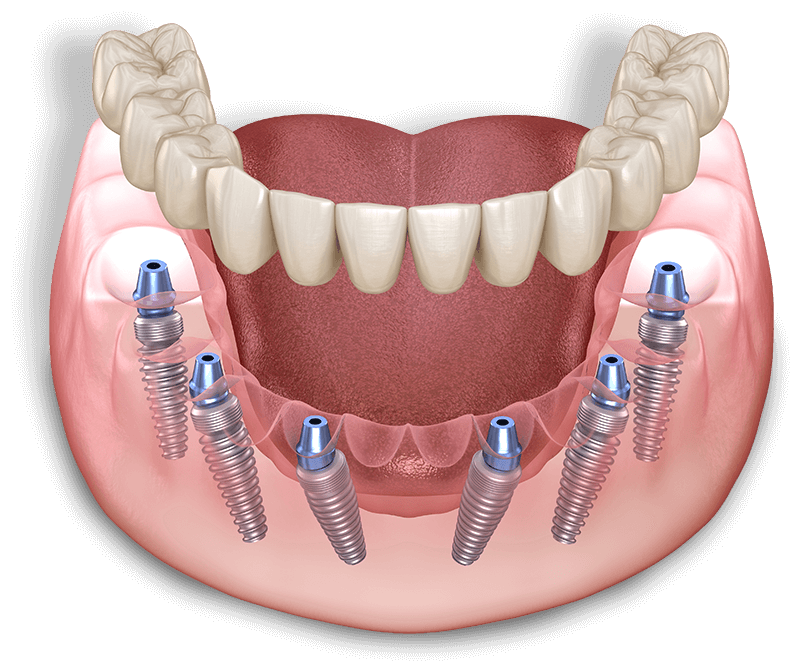
All-on-4 / All-on-6 & Full-Arch Immediate-Load Implants
Full-arch solutions use 4–6 implants to support a fixed prosthesis for people missing most or all teeth. Often done with immediate-load protocols so patients leave with provisional teeth the same day.
Subperiosteal Implants
Placed on top of the bone and under the gum, subperiosteal implants are rarely used now. They can be an option for severe bone loss when grafting isn’t suitable.
Zygomatic Implants
These long implants anchor in the cheekbone (zygoma) for patients with extreme upper-jaw bone loss. They allow full-arch support without extensive grafting.
How Clinicians Decide Which Kind Is Right
Bone quantity and quality (CBCT planning)
3D CBCT scans show bone height, width, and nerve locations. This guides whether a standard implant, zygomatic option, or grafting is needed.
Number and location of missing teeth
A single gap usually needs one endosteal implant, several adjacent gaps may need an implant-supported bridge, and most or all missing teeth point to full-arch solutions like All-on-4/6.
Health, habits and timeline
Smoking, uncontrolled diabetes, or poor oral hygiene can affect healing. Some patients want immediate teeth; others prefer a staged plan for extra healing time.
Budget and long-term goals
Costs, longevity, and maintenance vary. Full-arch immediate solutions may cost more up front but can be more stable and life-changing long term.
Benefits and Risks by Kind
Endosteal: high success, moderate surgery, longer healing. Bridge: fewer implants, good function, depends on implant support. All-on-4/6: fast results, immediate function, higher surgical complexity. Subperiosteal/zgyomatic: options for severe bone loss but more specialized and less common. Grafting needs, recovery time, and cost rise with complexity.
What To Expect During Treatment
Expect a consult, CBCT and digital planning, possible guided surgery, and a timeline for provisional vs final restorations. Same-day provisional teeth are common for immediate-load cases; final prosthetics come after healing. Recovery includes short-term swelling, pain control, and gradual return to normal eating.
Why Choose In A Day Smile For Full-Arch & Immediate Solutions
In A Day Smile Dental Implant Centers, led by prosthodontist Dr. Burak Taskonak, specializes in immediate-load All-on-4 and All-on-6 full-arch restorations. Their in-house lab, digital workflow, guided surgery, and same-day prosthetics help deliver predictable results. The practice also offers a lifetime warranty, Best Price Guarantee, and financing options to support patients.
Questions To Ask Your Provider
– How many of these kinds of dental implants do you place? – Will I get a CBCT and a guided surgical plan? – Do you offer same-day teeth or staged treatment? – Is prosthetic design done in-house and is there a warranty? – What are expected costs, financing options, and recovery time?
Schedule a consult to review which kinds of dental implants best match your mouth, health, and goals. A short exam and CBCT scan can give a clear, personalized plan so you can move forward with confidence.