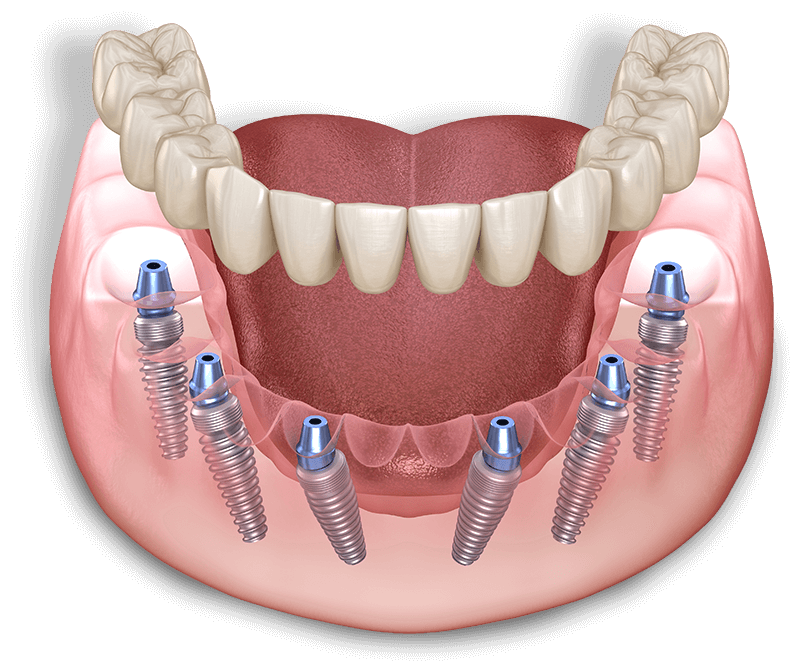
Mandibular implant surgery replaces missing teeth on the lower jaw with permanent implants. Many people choose this option to regain chewing ability, speech, and confidence lost to failing teeth or loose dentures. This article focuses on dental implant surgery and answers common patient concerns so you can decide whether a lower-jaw implant solution is right for you.
Read on to learn what mandibular implant surgery involves, who qualifies, the step-by-step process, risks and recovery, costs, and how to pick a provider for dental implant surgery in Fort Lauderdale, FL.
What is mandibular implant surgery?
Mandibular implant surgery places titanium posts into the lower jaw (mandible) to support crowns, bridges, or a full-arch prosthesis. Unlike single-tooth implants that replace one tooth, full-arch approaches replace an entire set of lower teeth and give fixed, denture-like function. Compared with traditional removable dentures, implants offer much better stability, chewing power, and a more natural look.
Immediate-load options—such as same-day full-arch solutions and All-on-6—allow a temporary fixed prosthesis on the day of surgery. These faster approaches can restore function quickly, though candidacy depends on bone quality and planning.
Who is a good candidate?
Oral and general health
Good candidates for dental implant surgery have controlled medical conditions and healthy gums. Uncontrolled diabetes, active periodontal (gum) disease, heavy smoking, or certain medications can raise the risk of complications. Your medical history and current health will be reviewed during the consult.
Bone volume and imaging needs
Enough bone in the lower jaw is essential to anchor implants. A Cone Beam CT (CBCT) scan and 3D planning show bone volume, nerve position, and other anatomy. Accurate imaging is especially important for mandibular cases to avoid nerve injury and to plan implant angles for strong long-term support.
Expectations and lifestyle
Fixed implant bridges suit patients who want a permanent, low-maintenance solution and who prioritize chewing strength and appearance. Removable overdentures may be better for those seeking lower upfront cost or who prefer removable care. Your lifestyle, diet, and expectations help determine the best choice.
Step-by-step: how the procedure works
Consultation and digital planning
Initial steps include a clinical exam, CBCT scan, and smile simulation. Digital planning software maps implant positions, predicts prosthetic outcomes, and creates a surgical guide. This planning stage is key to predictable results for dental implant surgery in Fort Lauderdale, FL.
Surgery day: guided placement and immediate prosthesis
On surgery day, a guided surgical guide positions implants precisely. Many clinics offer immediate-load workflows, meaning a provisional fixed prosthesis is attached the same day. This allows patients to leave with functional teeth while implants heal.
In-house lab, final restorations, and follow-up
An in-house milling or 3D printing lab speeds the transition from provisional to final prosthetic. Final restorations are adjusted for fit, bite, and esthetics. Follow-up visits monitor healing and occlusion to ensure long-term success.
What recovery looks like
Recovery typically involves 1–2 weeks of soft diet, swelling and mild discomfort for a few days, and medication for pain control as needed. Numbness or altered sensation can occur temporarily. Most patients resume normal activities within a week but follow all post-op directions and attend scheduled check-ups.
Risks, complications, and how they’re managed
Short-term issues include swelling, bleeding, bruising, and temporary numbness. Less common but serious risks are nerve injury, infection, and implant failure. CBCT imaging and guided surgery significantly reduce the chance of nerve damage and improper implant placement.
- Watch for increasing pain, fever, heavy bleeding, or prolonged numbness—these need urgent care.
- Early treatment of infection, removal of a failing implant, or revision surgery are typical management options.
Cost, insurance, and financing for dental implant surgery in Fort Lauderdale, FL
Costs vary based on the number of implants, need for bone grafts, immediate versus staged approach, materials, and lab work. Insurance often covers some surgical or extraction costs but rarely covers full-arch implant prosthetics. Many practices offer financing, in-house pricing guarantees, and travel dentistry packages to lower overall cost. Ask your provider for a clear written estimate and available payment plans for dental implant surgery in Fort Lauderdale, FL.
How to choose a provider for dental implant surgery in Fort Lauderdale, FL
At your consult, ask about the clinician’s experience placing and restoring implants, number of full-arch cases completed, complication rates, and warranty policies. A provider who both places and restores implants can streamline care and improve outcomes.
In A Day Smile Dental Implant Centers and Dr. Burak Taskonak offer advanced digital planning, an on-site lab, immediate-load All-on-6 options, and a lifetime warranty. Dr. Taskonak has placed over 20,000 implants and leads a team that performs guided surgery with sedation options to keep patients comfortable through complex same-day procedures.
To move forward, schedule a consultation and bring medical records, recent dental X-rays, and a list of medications. Prepare questions about experience, technology used (CBCT, guided surgery), recovery, costs, and warranties. A clear consult will help you decide if mandibular dental implant surgery is the right path to restore your lower jaw and quality of life.